
Surfing in Taghazout and Tamraght: breaks, seasons and practical tips
Published on 20 October 2026
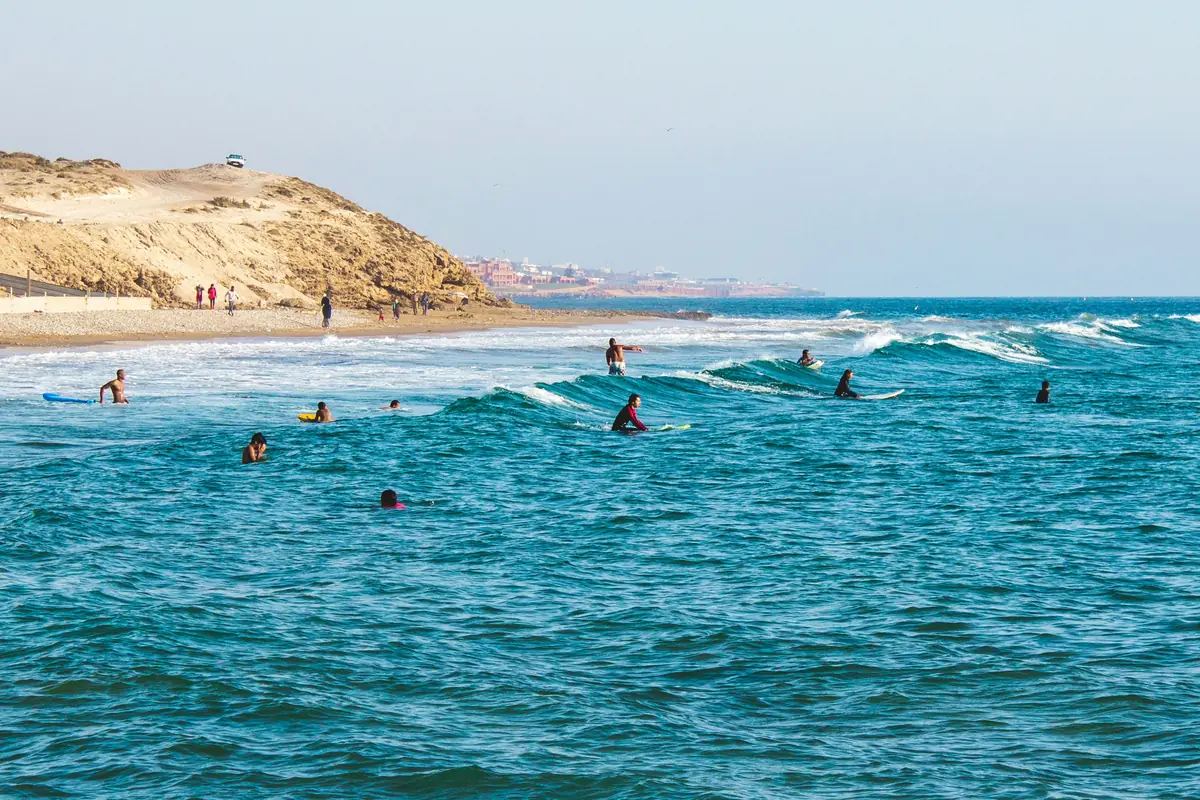
Surfing in Taghazout draws riders of every level, from first-timers in the whitewater to experienced surfers chasing the long winter right-handers. Together with Tamraght, its slightly quieter neighbour, this stretch of coast just north of Agadir packs a wide choice of breaks, schools and surf camps into a short enough distance that you can sample several in a single week.
This guide covers the main spots and the level each one really asks for, the best season for your experience, water temperatures, where to learn, and the easiest way to hop between breaks by car from Agadir.
Taghazout and Tamraght breaks, level by level
The coastline mixes rocky points, reefs and sandy beaches. The breakdown below follows the regional tourist board's guidance, but bear in mind that the same spot can feel completely different depending on swell size, tide and wind. "All levels" means beginner-friendly in small conditions, not every day of the year.
For experienced and expert surfers
- Killer Point: a powerful wave for experienced surfers only, definitely not one for beginners.
- Anchor Point: Taghazout's signature point break, for advanced surfers. When it is on, the line-up gets busy, so respect the priority rules.
- Panoramas and Mysteries: both for advanced surfers; leave them alone until you are confident with positioning and getting in and out.
- Boilers: an expert spot, with rocks and an entry that call for real experience.
For improvers
- Hash Point: best suited to intermediate surfers, a good step once you start riding unbroken waves.
- Banana Point: listed as all levels and popular with longboarders, ideal for softer, mellower waves.
For beginners (in small conditions)
- La Source, Crocodile and Devil's Rock: described as all levels. On small days they are reassuring options for your first sessions; when the swell picks up, they become noticeably more demanding.
Before paddling out at an unfamiliar break, spend a few minutes watching from the beach or the cliff: where the locals get in and out, where the rocks are, how the current moves. Asking at a surf shop or a school is always the smart move.
When to go: winter swells or calmer summer?
From October to March, the coast picks up the big Atlantic swells. This is prime time for the right-hand points that experienced surfers travel for. Beginners can still surf in these months, but you will need to pick your spots and days carefully, ideally with a school that knows where to find sheltered waves.
Spring and summer usually bring calmer conditions that suit learning much better. Waves are smaller and more consistent, and the sandy beaches turn into perfect classrooms. If your goal is to stand up on a board for the very first time, these seasons are often the most comfortable.
Water temperature and what to pack
This part of the Atlantic never gets truly warm. Around Agadir, the water sits at about 17 °C at its coldest, in February and March, and reaches roughly 20-21 °C at its warmest, in September and October. A full wetsuit is the norm for much of the year; at the end of summer some surfers get away with a thinner suit. Schools and surf shops rent them out if you would rather not fly with your own.
Also bring water-resistant sun cream, a bottle of fresh water to rinse off, and reef booties if you plan to surf the rockier breaks.
Learning to surf: schools and beginner beaches
Taghazout and Tamraght are home to plenty of surf schools and surf camps offering group lessons, private coaching and week-long packages with equipment included. Their big advantage is that instructors choose the most suitable beach each day, so you will not end up on a wave that is too powerful for you.
For a change of scene, two spots further north are known for learning: Tamri beach, recommended for beginners, and the bay of Imsouane, widely considered ideal for learning thanks to its long, steady wave. More on both below.
Getting there from Agadir and moving between breaks
Taghazout is about 25 km from Agadir, roughly a 40-minute drive along the coast road, according to the official Taghazout Surf Expo website. Tamraght sits on the way, between the two. Taxis are available, but a car makes all the difference when you want to follow the swell: if one break is flat in the morning, you simply head to the next without waiting for anyone.
If you are flying in, car hire at Agadir Al Massira airport lets you drive straight to the coast with your boards. Vocarz also delivers free of charge to Taghazout and Tamraght, to your hotel or surf camp, 24/7, and collects the car from the same place at the end of your stay. You pay on delivery, with nothing to pay in advance.
Carrying your boards
Not every board travels the same way. A shortboard will often fit inside with the rear seats folded down, while a longboard needs a bigger car or roof bars with straps. At Vocarz, surfboard racks are available on request: just mention it when you book. Browse our car range to pick a suitable model, and protect the interior with a board bag or a towel: sand, wax and salt water get everywhere fast.
Parking without nasty surprises
In car parks near the breaks, leave nothing on show: no board, no bag, no phone. Keep valuables on you or leave them at your accommodation. Choose busy spots and, if there is a parking attendant, it is worth asking them to keep an eye on the car. Finally, rinse off before getting back in, and return the car with the same fuel level you started with.
Going further: Tamri and Imsouane
Once you have explored the local breaks, the coast road north offers great day trips. Tamri, about 45 minutes from Agadir, combines a beginner-friendly beach with a river estuary and banana plantations. Imsouane, about 85 km from Agadir via Tamri, or around 1 hour 40 minutes on the road, lies a few kilometres off the N1 along a minor road. Its bay is renowned as an ideal place to learn and improve.
With unlimited mileage included at Vocarz, these trips cost you nothing beyond fuel. And if you carry on to Essaouira, the one-way rental is free: you drop the car off there at no extra charge. Our guide to the coast road to Essaouira covers the stops along the way.
Mixing surf with sightseeing
Flat days and late afternoons are perfect for other outings. From Tamraght, the inland road leads to Paradise Valley and its natural rock pools. If your trip falls in October, also check out the Taghazout Surf Expo, the surf trade fair held in Taghazout.
The bottom line
Surfing in Taghazout and Tamraght offers breaks for every level, as long as you match the wave to the moment: winter for powerful swells, spring and summer for learning. A car gives you the freedom to chase conditions, carry your boards and push on to Tamri or Imsouane. At Vocarz, you can hire with no deposit and fully comprehensive insurance included, from €20 a day with a 3-day minimum.
Frequently asked questions
Do I need a wetsuit to surf in Taghazout?
Yes, a full wetsuit is recommended for much of the year, as the water stays cool, especially in late winter. Schools and surf shops rent them locally.
Can beginners surf in Taghazout in winter?
It is possible, but you need to choose your days and spots carefully, ideally with a school. The calmer spring and summer months are usually more comfortable for learning.
Can the car be delivered straight to Taghazout?
Yes, Vocarz delivers and collects free of charge in Taghazout and Tamraght, at your hotel or surf camp, 24/7. You can also pick it up at Agadir Al Massira airport.
How do I carry a longboard in a hire car?
Choose a larger car or bring roof bars with straps. Browse our car range to find a suitable model.
What can I do on flat days?
Use them for an inland trip, for example to Paradise Valley, or drive further north to Tamri and Imsouane.
Ready to chase the swell between Taghazout and Tamraght?